

For children in South Africa, the latest Thrive by Five Index 2024 paints a sobering picture. But...
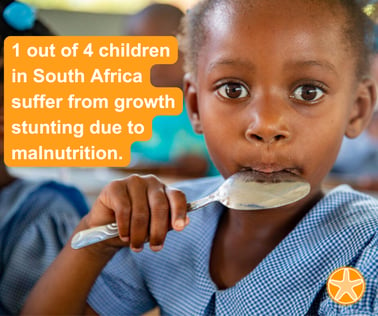
In South Africa, more than 1 in 4 young children are stunted, with nearly 4 in 10 living below the food poverty line.
Despite this year's increase, the child support grant amounts to only about R19 a day (approximately $1.17 / £0.88), which is far below what a young child needs to eat. At one of our partner playschools, switching to five hot meals a week for a four-year-old has improved her focus and health and inspired her to start thinking about her own future.
This example highlights the potential impact of scaling up child nutrition.
The lunchbox that was sometimes empty
When the cooks at a school in the Eastern Cape started serving lunch five days a week instead of some, one small girl noticed before anyone told her why.
Her name, for this story, is Nomvula. She's five. Her father works when there's part-time work to be found, and in her part of the Eastern Cape that isn't every week. Some mornings, Nomvula arrived at school without a lunchbox. Her teachers noticed her sitting a little apart at snack time, and then noticed something else: by mid-morning she'd stopped following the lesson. Her hand went up more slowly. Her head went down on the table before the other children's did.
It's a small thing to say out loud: a child who struggles to focus because she hasn't eaten. It's also one of the most quietly urgent facts about growing up in South Africa right now.
When the school began cooking for Nomvula five days a week, the change wasn't dramatic. It was steady. Her concentration came back first. Then her energy at outside play. Her teachers say she now sits through story time to the end, and that she talks about becoming a teacher herself one day: "so I can look after children the way you looked after me."
Nomvula's lunchbox is one child's story. What's happening to it is a national one.
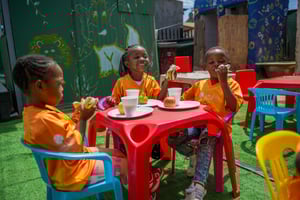
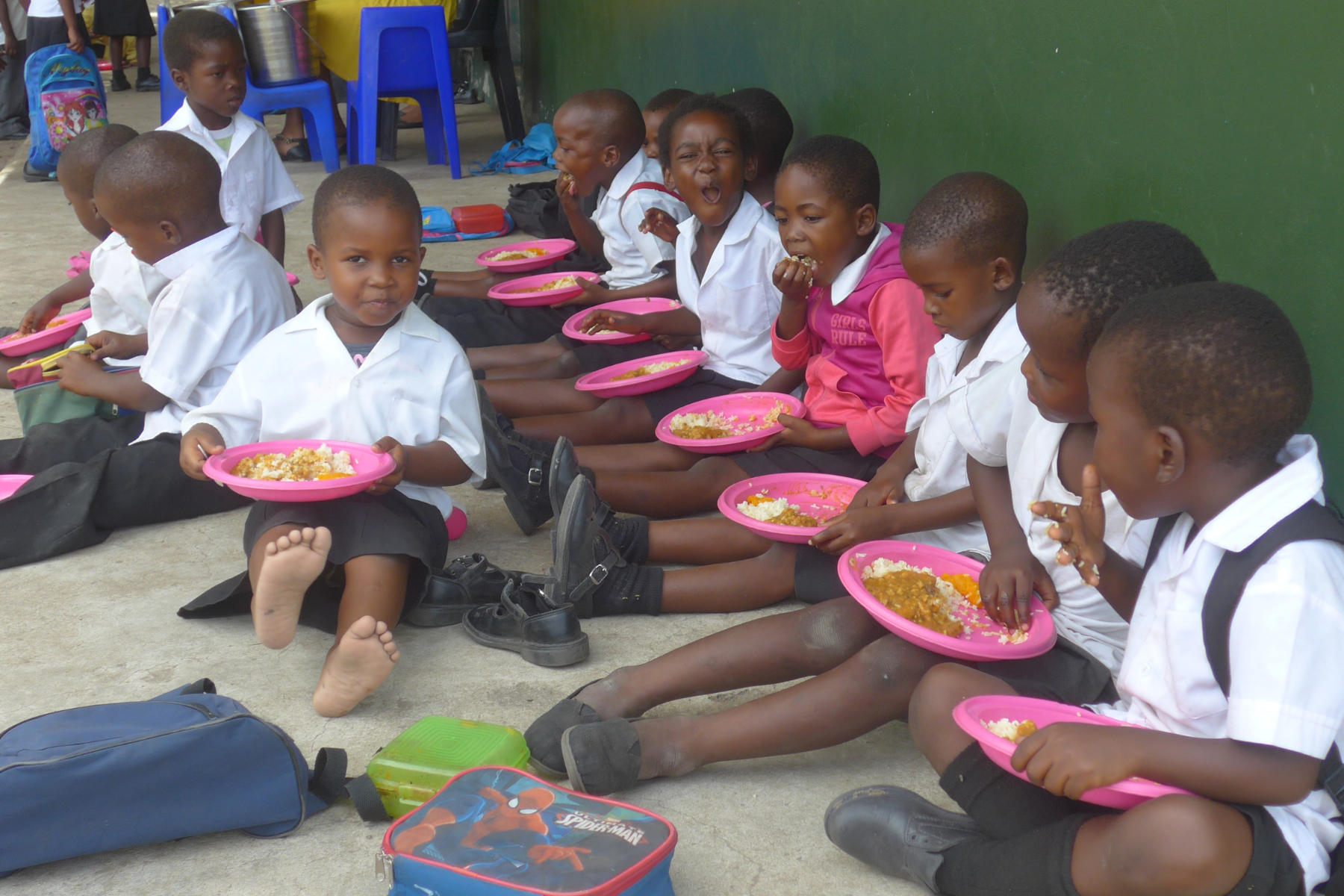 (Pictured above: Children enjoy a warm, nutritious meal during school. For some, this school meal is their only nutritious meal of the day.)
What does it mean when a child is "stunted"?
Stunting isn't about a child being short for their age, though that's the visible sign. It means a child's brain and body haven't had enough of the right nutrients, for long enough, during the years when both are still being built, mostly before age two. The damage doesn't announce itself with a fever or a wound. It shows up years later, quietly, as a child who struggles to concentrate, falls behind at school, and, research increasingly shows, earns less as an adult than a child who wasn't stunted.
According to an analysis published in July 2026 by the Children's Institute at the University of Cape Town, more than 1 in 4 young children in South Africa are stunted, and that number has stayed "stubbornly high" for decades. Governments have changed. Growth has come and gone. The number hasn't moved. Nearly 40% of South African children live below the food poverty line, currently set at R855 a month (~$53 / £40), or about R29 a day (~$1.78 / £1.34), per person.
Only 1 in 5 infants are exclusively breastfed for their first six months, and only 1 in 4 children aged 6–12 months get a minimally acceptable diet.
Those are national numbers. Nomvula is what one of them looks like up close.
Why doesn't the child support grant cover enough food?
The government's main tool against child poverty is the child support grant, and this year it went up, as it does most years, to R580 a month (~$36 / £27), or about R19 a day (~$1.17 / £0.88), for the roughly 13 million children who receive it. It's a real increase, and it matters. On its own arithmetic, it's also not enough to lift a child over the food poverty line of R29 a day (~$1.78 / £1.34), before a family has paid for anything else a child needs: transport to a clinic, a school uniform, electricity, soap.
We say this carefully, because raising the grant is one of the better things that's happened for South African children in the past decade, and the people who fought for that increase deserve credit, not a backhanded compliment. The point isn't that the grant is a failure. The point is that a R10-a-day (~$0.61 / £0.46) gap between what a grant provides and what a food-secure childhood costs is exactly the gap that community-based feeding programs like the one Nomvula's creche runs are built to close. One plate at a time, in the years when it matters most.
What actually reverses stunting in young children?
The Children's Institute's analysis finds that this isn't a new problem needing a new solution. The evidence for what works hasn't changed in a decade: a reliable, nutrient-rich daily meal, especially in the first 1,000 days and through the preschool years. What's changed is how many children it actually reaches.
That's the argument for schools like Nomvula's, and it's the argument our partner Community-Based Organizations make to us every quarter: a school that cooks five days a week isn't a nice extra sitting alongside "real" early learning. For many children, it is the intervention. You cannot teach a hungry four-year-old her colors before you've fed her.
How is Starfish responding to this?
We served 248,784 meals last year through our partner organizations' feeding programs across South Africa: school lunches, after-school meals, and food parcels for families going through the hardest months.
Every one of those meals sits inside the same gap the Children's Institute is describing: the space between a grant that helps and a plate that's actually in front of a child at lunchtime.
We don't claim those meals close the gap nationally. No single organization can. What we can tell you is what a meal buys, because we cost it out rather than round it up: $20 a month funds 30 nutritious meals for a child like Nomvula. That's less than the price of four coffees, and it stands between a child and the kind of hunger that quietly changes how a brain develops.
What can you do about child hunger in South Africa?
You can't fix a national grant system from where you're sitting, and we're not going to pretend you can. What you can do is make sure at least one school kitchen in at least one community never runs short, and that a child like Nomvula never again has to sit a little apart at snack time.
A gift of $20 a month is 30 meals. A gift of $30 funds a month of both meals and a healthcare check-up. Neither one waits for a policy to change first.
Stunting is one of the few crises in child welfare where we already know what fixes it. It has for years. What's missing is reach. Your gift buys reach directly, this month, for a child eating lunch at a playschool in the Eastern Cape.
In keeping with the POPIA Act, and to protect the identity of our children, names and faces may have been changed.
Sources:
-
Children’s Institute at the University of Cape Town. (2026, July 15). SA’s food system is failing children.